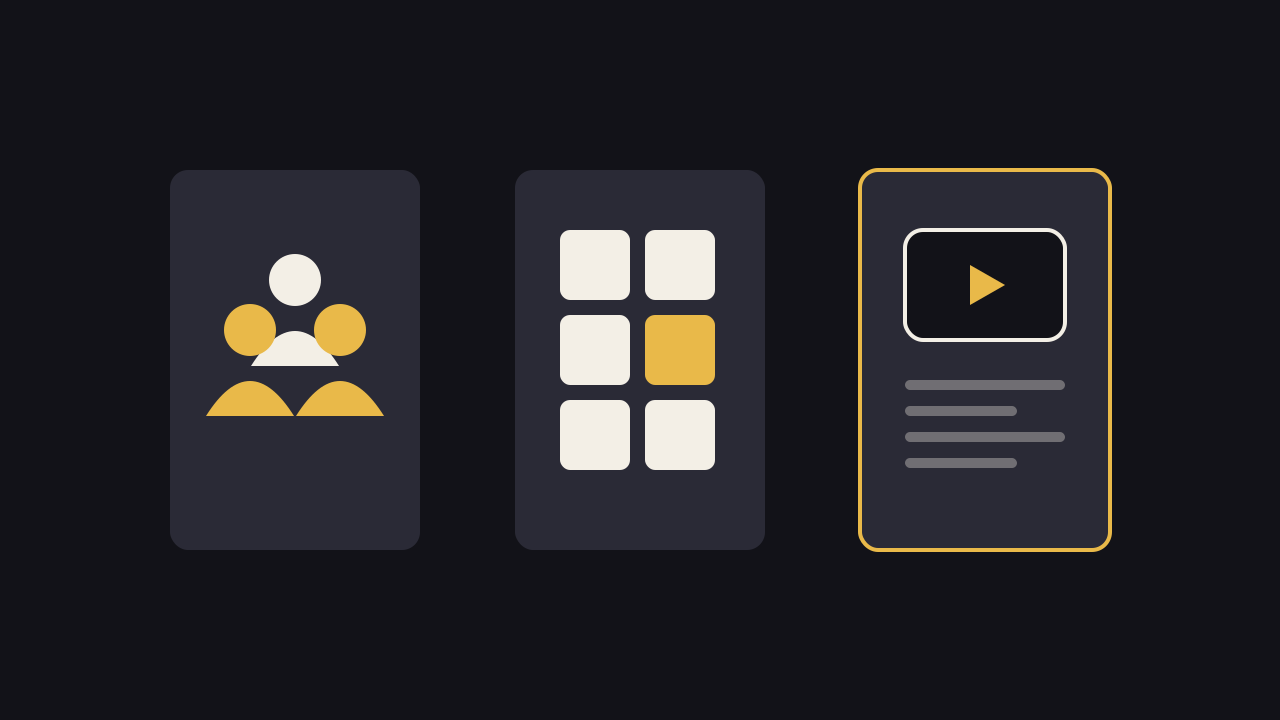
Corporate training companies come in 3 types. Workshop trainers send a person to teach your staff. Course libraries rent you seats in a catalog, such as LinkedIn Learning at $379.88 a seat a year. Custom course builders make a course from your own material, and you own it. Pick a trainer for skills people learn by doing together, a library for general topics, and a custom build when the course must teach how your company works.
What are the 3 types of corporate training company?
The 3 types are workshop trainers, course libraries and custom course builders. They sell different things: a person's time, access to a catalog, or a finished course. Most "top 10" lists mix all 3, which is why they are hard to compare.
| Type | What you get | Examples | How it is priced |
|---|---|---|---|
| Workshop trainers | A trainer, in person or live online | SkillPath, Dale Carnegie, FranklinCovey, DePaul University's corporate training | Quote per session or per group |
| Course libraries | Seats in a ready-made catalog | LinkedIn Learning, Udemy Business, Coursera for Business, Skillsoft | Per seat, per year |
| Custom course builders | A course made for your company, from your material | ELM Learning, AllenComm, SweetRush, small studios like ours | Per course, quoted once |
A 4th group shows up on these lists too: LMS software, like TalentLMS. That is where training lives, not who makes it. isEazy's 2026 list counts it as a provider type.
What do corporate training providers actually sell?
Corporate training providers sell a trainer's time, seats in a course library, or a course built for you. Many sell more than 1 of these. Here is what 7 providers say on their own websites, read on 16 November 2026. The list is in no order, and it is not a ranking.
- SkillPath (workshops): trainers who travel to your site, live virtual classes, on-demand courses on its own platform, and coaching. Topics include leadership, Microsoft Office, customer service and OSHA safety.
- FranklinCovey (workshops and a subscription): live online, live in-person and on-demand workshops, plus the All Access Pass, a subscription to its content and tools. Topics include leadership, trust and getting results.
- LinkedIn Learning (library): team seats in its course catalog, sold per license per year.
- Coursera for Business (library): a Team plan for up to 499 users, and an Enterprise plan for 500 or more.
- ELM Learning (custom): custom eLearning first, plus instructor-led training, learning strategy, and some off-the-shelf soft skills courses.
- AllenComm (custom): custom eLearning, blended learning and learning portals, for onboarding, compliance, leadership and sales.
- SweetRush (custom): custom learning in formats like eLearning, microlearning, video and VR, plus extra staff for training teams.
The word on the website, agency, supplier or provider, does not tell you which type you are buying. Read what they sell. None of the 5 workshop or custom providers above posts a price on the page we read. Each one asks you to get in touch.
What do workshop training companies do?
Workshop training companies send a trainer to teach your team, in a room or on a live video call. SkillPath offers 4 formats: in person, live online, on-demand courses on its own platform, and coaching. None of the workshop firms read for this page publish a price. You ask for a quote.
University programs work the same way. DePaul University's School of Continuing and Professional Studies runs onsite workshops for companies, nonprofits and government, on topics like leadership, Six Sigma and PMP exam prep.
Workshops suit skills people practice together: leading a team, handling hard talks, selling. They are weaker for things every new hire must learn the same way, every month. Once the trainer leaves, the training leaves with them.
What do course library companies charge?
Course libraries charge per seat, per year. LinkedIn Learning Teams costs $379.88 per license a year for 2 to 20 licenses, billed yearly, by LinkedIn's help page. Coursera for Business sells a Team plan for up to 499 users, and quotes larger groups. Skillsoft publishes no list price.
| Library | Published price | Notes |
|---|---|---|
| LinkedIn Learning Teams | $379.88 per license a year | 2 to 20 licenses; 21 or more goes to sales |
| Coursera for Business Team | Price did not show on its page when checked | Up to 499 users; 500 or more is quoted |
| Skillsoft | Not published | Quote only |
| Udemy Business | Not checked, the page blocked our reader | Team and enterprise plans |
The cost grows with your headcount. At $379.88 a seat, a team of 20 costs about $7,600 a year, every year. That is our math on LinkedIn's price. Above 20 seats, LinkedIn quotes a price instead.
A library is a good deal for general topics: Excel, time management, writing. It cannot teach your own process, your software setup or your safety rules.
Which corporate training programs can a company buy off the shelf?
You can buy general skills programs off the shelf: leadership, communication, Microsoft Office, time management and customer service. They come as library seats, a subscription, or single ready-made courses. You cannot buy a course on your own process, tools or rules. That has to be built.
| Off-the-shelf option | Seller | How you buy it |
|---|---|---|
| Online course catalog for teams | LinkedIn Learning | Per license, per year, after a 1-month free trial |
| Online course catalog for teams | Coursera for Business | Team plan per user, per year; Enterprise is quoted |
| Workshops and content subscription | FranklinCovey | All Access Pass, price on request |
| On-demand courses | SkillPath | On its own learning platform, price on request |
| Single soft skills courses | ELM Learning | Courses on communication, emotional intelligence and conflict resolution |
Online corporate training from a library is the fastest to start. LinkedIn sells 2 to 20 seats online with a 1-month free trial, so a small team needs no sales call.
What does a custom training company build?
A custom training company builds a course from your own documents, experts and rules. You get lessons that show your people, your tools and your steps. When the work is paid for, the course is usually yours to keep and change.
Custom work is priced per course. The best-known numbers are old. The Chapman Alliance's 2010 data put 1 finished hour of basic eLearning at about $10,054 to build in-house, and interactive eLearning at about $18,583, by Learnframe's summary. Prices have moved since 2010, so use them only for scale.
SweetRush, a custom developer, argues that custom starts to pay off at around 1,000 learners, and for content that is specific to your company. It also says off-the-shelf is a good fit for general knowledge. That is one vendor's view, not a study.
Here is what custom looks like in practice. For a staffing agency in Canada we built 15 courses of 6 lessons each, 90 lessons in all, for hotel, cleaning, coffee shop and restaurant staff. We interviewed hospitality experts, and for the barista course we sent a videographer to film real work instead of using stock footage.
For a trucking company, the onboarding sat in PDFs and slides. We pulled it into 1 course, called the staff who knew the unwritten parts, and used photos of the company's own trucks. A library seat could not show those trucks.
Our custom training company page shows how we build from your own material, and our course creation services page covers full courses for training companies.
How do training suppliers price their services?
Training suppliers price corporate training services 3 ways. Libraries charge per seat, per year. Workshop trainers quote per session or per group. Custom builders quote per course. Only the libraries post figures, and even some of those do not show a number.
| Price model | Who uses it | Published figure, read 16 November 2026 |
|---|---|---|
| Per seat, per year | LinkedIn Learning Teams | $379.88 per license a year, 2 to 20 licenses online |
| Per user, per year | Coursera for Business Team | No figure; the price did not load on its plans page |
| Quote after a call | SkillPath, FranklinCovey | None |
| Quote per project | ELM Learning, AllenComm, SweetRush | None |
For custom work, the oldest public figures are the Chapman Alliance's 2010 numbers: about $10,054 to $18,583 to build 1 finished hour of eLearning in-house, by Learnframe's summary. Treat them as scale, not as a quote. Coursera does list 2 terms: a 14-day money-back guarantee on Team, and 25% off Team licenses for nonprofits.
How do you pick the right corporate training company?
Pick by what the training must do, then ask each company the same questions. If the content is the same for every company, rent it. If it is about how your company works, build it. If it is a skill people practice live, book a trainer.
Clarity Consultants lists 7 questions for an instructional design partner. In short:
- What similar projects have you done?
- How will the content tie to our business goals?
- Which design models do you use, and why?
- How will you measure success?
- How do you use adult learning principles?
- What tools will you build in?
- How do you handle changes in the middle of the project?
"Effective consultants should have clear metrics for assessing the impact of their training."
Clarity Consultants, "Instructional Design Consulting: Choosing the Right Partner for Your Business"
Add 2 questions of your own for a custom builder. Ask who owns the source files when the job is done. And ask to see 1 finished lesson before you pay for the whole course.
We always build the first lesson first, so you see the look and the pace before anything else is built. Our guide to off-the-shelf vs custom eLearning goes deeper on the rent-or-build choice.
Can you trust "top corporate training companies" lists?
Read them with care. Some lists are made by the companies they rank: isEazy's 2026 list puts its own product first. Training Industry's lists are judged by its own team on set criteria, and its leadership list says the companies are not ranked.
Training Industry's 2026 custom content list names its criteria: the scope and quality of the work, the client portfolio, business growth, and market presence. That page also names sponsors. A sponsor is not the same as a winner, so check which is which.
Before you trust a list, check 3 things: who wrote it, whether the writer is on it, and whether it says how it picked.
How do you shortlist training companies yourself?
You can build a shortlist in 1 to 2 days. Here is how.
- Write down the job. In 1 page: who learns, what they must do after the course, and how you will check it.
- Sort each topic into a type. General topic: library. Live skill: trainer. Your own process or rules: custom.
- Price the library first. Multiply your headcount by the seat price, then by the years you will keep it.
- Find 3 companies per type. Use Training Industry's lists, the SHRM vendor directory, and peers in your field.
- Send everyone the same brief. A training needs analysis makes the brief clear.
- Ask for a sample. A real lesson from a past project, or a first lesson of yours.
The 3 mistakes that cost the most.
- Comparing a yearly seat price with a one-time build. Put both on the same number of years.
- Buying a library for a company-specific topic. Staff finish the course and still do not know your process.
- Signing for the whole course before seeing 1 lesson. You find out about the style only when it is too late to change it.
Want to see what a custom course would look like for you? We build your first lesson and your full course map for free, from what you already teach. Get your free first lesson.
Other questions about corporate training companies
What does a corporate training company do?
It trains your staff in one of 3 ways: a trainer teaches them live, a library gives them seats in a catalog of courses, or a builder makes a course just for your company. Many companies offer more than 1 of these.
How much do corporate training companies charge?
Libraries publish seat prices, like LinkedIn Learning Teams at $379.88 a seat a year. Workshop trainers and custom builders quote per job. None of the workshop or custom firms read for this page published a rate.
Is a course library or a custom course better?
A library is better for general topics and small teams. A custom course is better when the course must teach your own steps, tools or rules. SweetRush, a custom builder, puts the break-even at around 1,000 learners.
Do I own a course a training company builds for me?
Often, but only if the contract says so. Ask who owns the final course and the source files, such as the Articulate Storyline files, once the last invoice is paid.